A patient-owned health record platform for secure medical data sharing, healthcare interoperability, consent management, and AI-powered health data infrastructure.
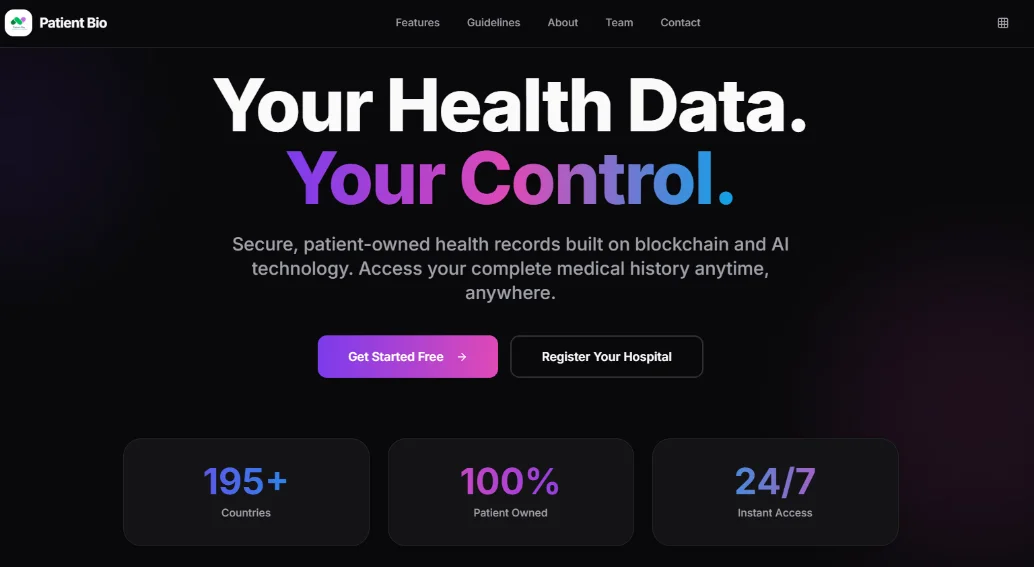
Health records that belong to everyone except the patient
Patient health data is fragmented across hospitals, clinics, diagnostic labs, and pharmacies — each holding a partial, disconnected record. Patients have no single, trustworthy view of their own health history, and no real control over who can access it. When a patient switches providers or seeks a second opinion, critical history is often lost, re-requested on paper, or simply unavailable — creating risk, delay, and duplicated tests. Patient Bio set out to solve this at the infrastructure level: give patients ownership of their own records, and give providers a secure, consent-based way to access them.
Target Users
Who Patient Bio is built for
Patients who want a single, portable, trustworthy record of their own health history
Healthcare providers — clinics, hospitals, and diagnostic centers — needing secure, consent-based access to patient history
Health systems and insurers interested in interoperable, auditable health data infrastructure
My Role
What I owned
Founder & product vision — defined the problem, the patient-owned data thesis, and the roadmap
Product design — designed the patient and provider-facing experience end-to-end
System architecture — designed the multi-layer architecture spanning mobile, API, database, and blockchain
Software engineering — built the core platform across mobile, backend, and blockchain layers
Product Features
What the platform does
Patient-owned health record vault — secure, portable, always accessible
Consent management — grant, view, and revoke provider access anytime
Provider access portal for authorized data requests
Immutable audit trail of every access and consent event
AI-assisted health record summarization (roadmap)
Cross-provider record interoperability
Tech Stack
Built with
Mobile
React Native
Backend
Node.jsExpress.js
Database
PostgreSQLMySQL
Blockchain & Storage
Hyperledger FabricIPFS
Cloud
AWS
Architecture
How the system is layered
Patient & Provider Apps
React Native mobile app for patients; web portal for provider access requests.
↓
API Layer
Node.js + Express — authentication, business logic, and orchestration.
↓
Data Layer
PostgreSQL/MySQL for structured records; IPFS for secure encrypted document storage.
↓
Consent & Access Ledger
Hyperledger Fabric — permissioned blockchain recording every consent grant, revoke, and access event.
↓
Cloud Infrastructure
AWS — hosting, storage, and scaling.
Challenges
What was hard about building this
Challenge
Balancing patient privacy with provider usability
How it was addressed
Consent flows needed to be strict enough to protect patients, yet simple enough for a provider to use in a busy clinic. Solved with a streamlined request/approve flow and clear consent scopes.
Challenge
Keeping bulk medical data off-chain while keeping the ledger meaningful
How it was addressed
Storing full medical records on-chain isn't practical or necessary. Storage (IPFS/SQL) was separated from the consent and access ledger (Hyperledger Fabric).
Challenge
Designing for interoperability across inconsistent provider systems
How it was addressed
Every clinic and hospital structures records differently. Addressed with a normalized data model and a mapping layer for structured import.
The Solution
Consent as the center of the architecture
Patient Bio's architecture separates concerns deliberately: patient identity and consent live on a permissioned blockchain layer that no single party controls, medical documents are stored securely off-chain, and a mobile-first experience puts the patient — not the provider — at the center of every access decision. The result is a system where a patient can see exactly who has their data, grant a new provider access in seconds, and revoke it just as fast.
Results
Where the project stands
8
Weeks to MVP
15
Investors at CES Demo
5
System Layers Built
Consent
Access Model
Designed and built a working, end-to-end architecture spanning mobile, backend, database, and permissioned blockchain layers
Validated the product thesis on international innovation stages, including a Top-15 finish at Startup World Cup (CES 2026)
Established a technical foundation for consent, access logging, and auditability from day one
Current status: active development toward pilot validation with healthcare partners
Lessons Learned
What this taught me
Compliance and consent architecture must be designed first, not retrofitted
Founders who understand both the clinical and technical side move faster than teams that split the two
Patient trust is a product feature, not a marketing line — it has to be engineered in
Building something in healthcare, AI, or blockchain?