Gemini 3.6 Flash: More Powerful Agentic AI Using 17% Fewer Tokens
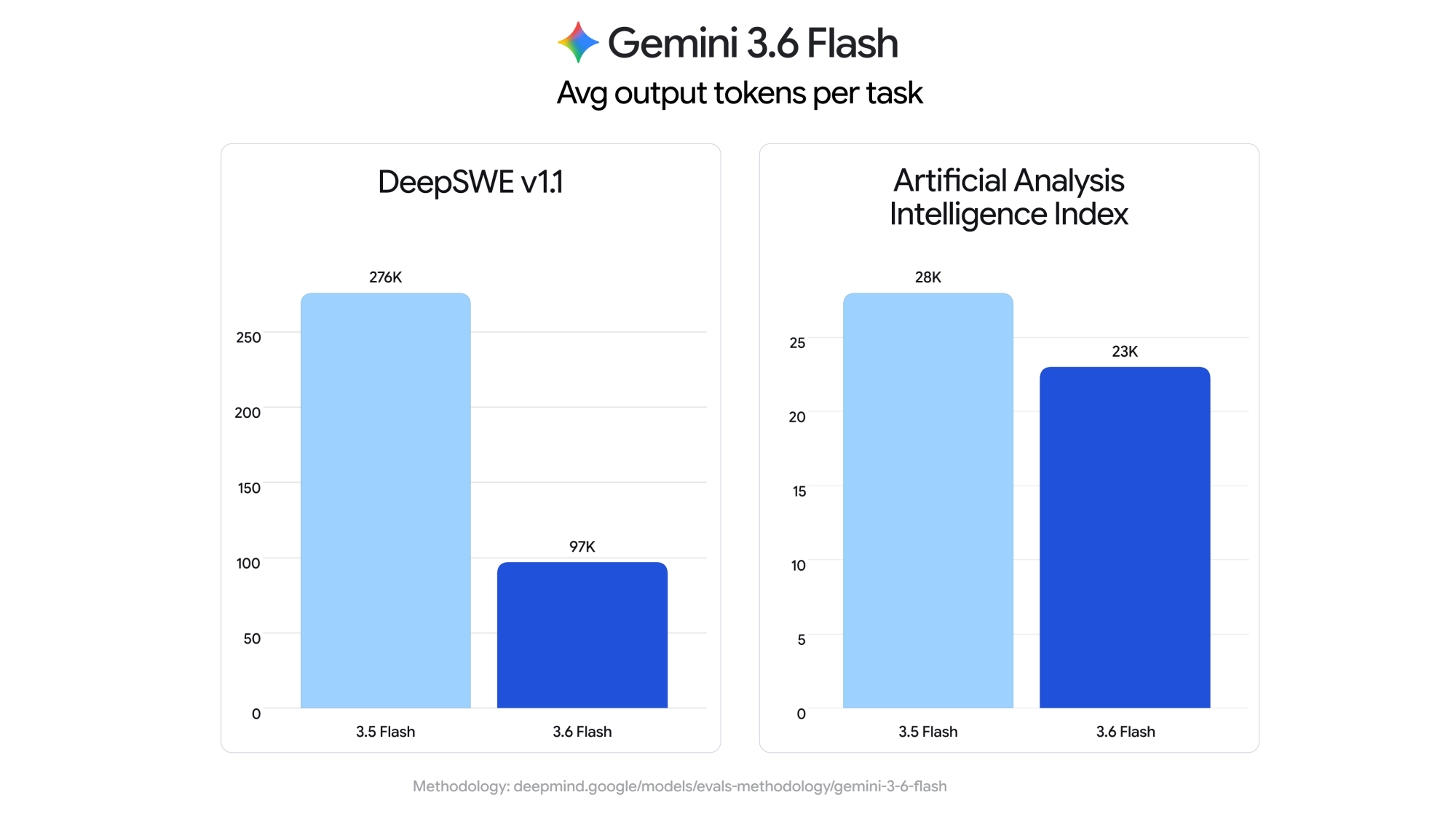
AI models usually become more expensive as their capabilities improve. Conversely, reducing costs often requires compromising reasoning quality, reliability, or task performance. Google’s Gemini 3.6 Flash appears to challenge this traditional trade-off by using fewer tokens, reducing output-token pricing, and improving performance across several important benchmarks.
On July 21, 2026, Google introduced Gemini 3.6 Flash, Gemini 3.5 Flash-Lite, and Gemini 3.5 Flash Cyber. These models were designed for faster execution, lower latency, improved token efficiency, and large-scale agentic AI workloads.
What Makes Gemini 3.6 Flash Different Gemini 3.6 Flash is priced at $1.50 per one million input tokens and $7.50 per one million output tokens. The previous Gemini 3.5 Flash reportedly had the same input price, but its output-token price was $9.00. Based only on output pricing, the new model is approximately 16.7% cheaper. Google reports that Gemini 3.6 Flash uses 17% fewer output tokens than Gemini 3.5 Flash on the Artificial Analysis Intelligence Index. The model can also complete multi-step workflows using fewer reasoning steps and tool calls. This means the improvement is not limited to a lower price per token. The total number of tokens required to complete an agentic workflow may also decrease. That distinction is important for production AI systems. An API bill does not depend only on the model’s listed price. The actual cost is affected by the number of reasoning steps, tool calls, retries, context tokens, and generated output required to complete each task.
Coding and Research Performance On DeepSWE, a benchmark focused on long-horizon software engineering, Gemini 3.6 Flash reportedly achieved 49%, compared with 37% for Gemini 3.5 Flash. On MLE Bench, which evaluates machine learning research capabilities, the new model achieved 63.9%, a significant improvement over the previous model’s 49.7%. Its result on OSWorld-Verified, a computer-use benchmark, reportedly increased from 78.4% to 83%. On the GDPval-AA v2 knowledge-work benchmark, the score increased from 1,349 to 1,421. These results suggest that the model may be useful beyond general chat and content generation. Potential applications include code migration, structured research, document analysis, software engineering, and tool-using AI agents. However, benchmark scores should not be treated as guarantees of production performance. A model that performs well on a coding benchmark may behave differently when working with Bengali content, industry-specific information, strict structured outputs, or a specialized business workflow. Startups should therefore evaluate models using their own real-world datasets and use cases before making a production decision.
Where Gemini 3.5 Flash-Lite Fits Gemini 3.5 Flash-Lite is designed for high-volume and low-latency workloads. Its reported standard API price is $0.30 per one million input tokens and $2.50 per one million output tokens.It may be suitable for tasks such as: 1. Document classification 2. Receipt and invoice processing 3. Translation 4. Product-data extraction 5. Bulk search 6. Customer-support routing 7. Simple agent subtasks
A cost-efficient AI architecture could use Gemini 3.6 Flash as the primary reasoning or orchestration model while using Flash-Lite as a worker model.
The AI industry is now competing in two parallel races: building the most capable models and making intelligence faster, cheaper, and more accessible. Gemini 3.6 Flash demonstrates how an AI model can potentially become more capable, less verbose, and more affordable at the same time. This is particularly important for startups and independent developers in Bangladesh, where the cost of every API call can directly affect product sustainability and profitability. In my view, successful AI products will not depend on a single powerful model. They will use intelligent model routing, selecting different models based on task complexity, cost, risk, and required accuracy. Sustainable AI engineering will involve controlling token usage, incorporating human approval, measuring task-level performance, and calculating the true cost of every successful outcome. For your AI product, which is more important: maximum intelligence or reliable performance at a lower cost?
Discuss this with me →